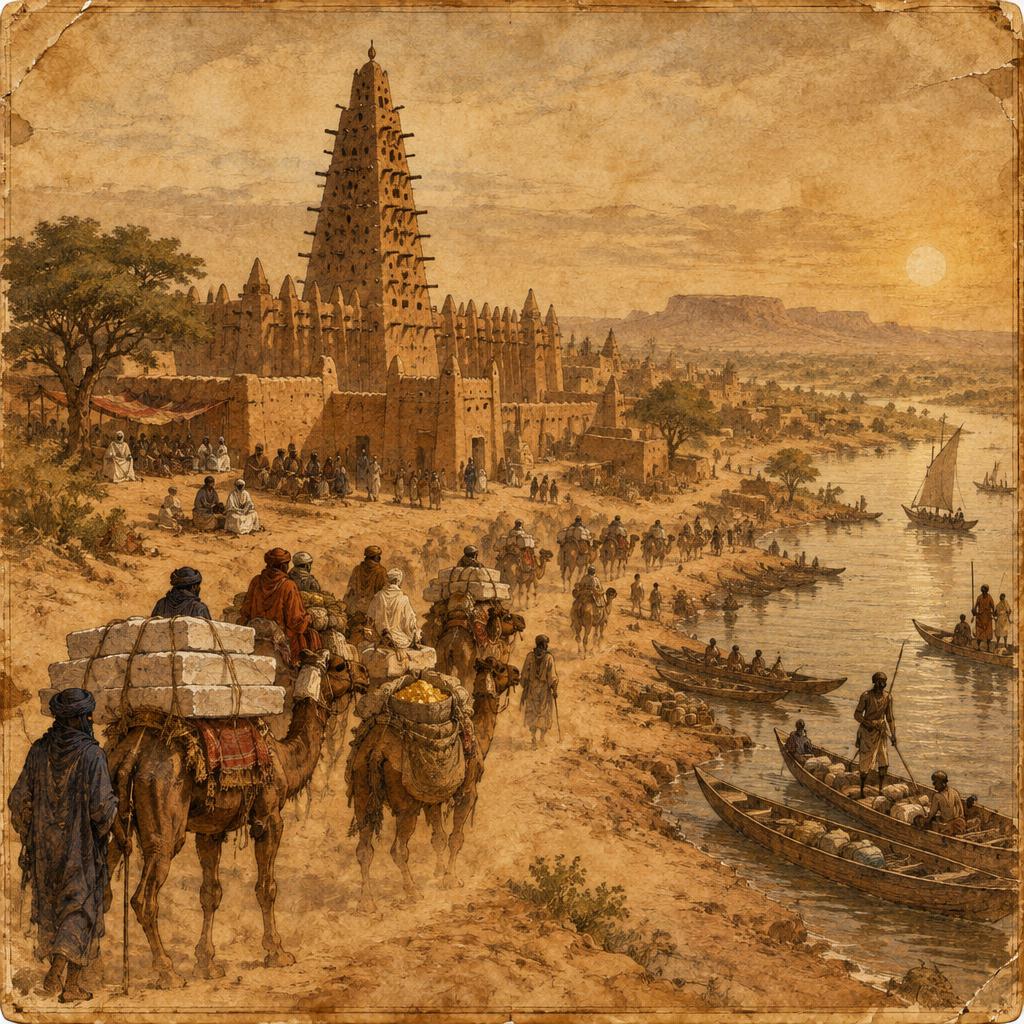
Salt, Gold & Sand: The Songhai Empire
One of the largest states in African history — its desert roads, its university city, and the musket volley at Tondibi that broke it open.
How one event spilled into the next
Sunni Ali takes the river roads
He seizes Timbuktu and Djenné, putting the salt-for-gold trade under one crown.
Raids into Hausaland
Askia Muhammad campaigns east; Hausa cities in today's northern Nigeria feel Songhai's pull.
The guns at Tondibi
About four thousand Moroccan troops with muskets break a cavalry army; the empire shatters into warlord states.
The roads outlast the crown
Hausa-Fulani northern Nigeria and Timbuktu's manuscripts still carry Songhai's administrative memory.
Did you know?
At its height Songhai stretched along well over 1,000 km of the Niger, from the Atlantic side of Senegal to Hausaland.
Timbuktu's Sankoré mosque drew scholars from across West Africa; families there still guard hundreds of thousands of old manuscripts.
Askia Muhammad left for Mecca in 1496 with 500 horsemen and a train of gold, and bought a hostel in Mecca for West African pilgrims.
Leo Africanus wrote that Askia Muhammad's armies made Katsina and Kano pay tribute around 1513 — historians still debate how far Songhai rule reached.
Key figures
- Sunni Ali BerWarrior-king who seized Timbuktu and built the empire, 1464–1492
- Askia Muhammad TureReformer who gave Songhai its ministries, army and tax system
- Ahmad Baba of TimbuktuScholar of Sankoré, carried off to Marrakesh after the fall
Where this comes from
- John Hunwick, Timbuktu and the Songhay Empire (1999)
- Leo Africanus, Description of Africa (1550)
- Michael Gomez, African Dominion (2018)
Dates marked by tradition or legend are given as approximate.
Other sides of the story
Gathering perspectives…
What do you remember?
Preparing your quiz…
Every border, every spillover
All 240+ lectures, new seasons monthly, and the full event-cascade timelines. Watch on any device.
Cancel anytime · No card to browse previews